 DVD
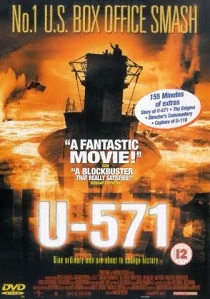
DVD The Allies are fighting a losing battle in the Atlantic as German U-boats pick off shipping with ease. However, things are about to change when a group of American sailors are sent on a secret mission to recover an Enigma coding machine from a stricken German submarine.

Details
It is 1942 and German U-boats are wreaking havoc in the North Atlantic, sinking Allied shipping and threatening the vital supply lines between America and Britain. The Allies are struggling to combat the threat because German naval communications are protected by the Enigma cipher, allowing U-boats to receive their orders without the Allies being able to understand them.
When intelligence reveals that the damaged German submarine U-571 is awaiting assistance in the Atlantic, the Americans devise a daring plan. A specially selected crew will travel aboard the submarine S-33, disguise themselves as a German resupply team and board U-571 before the genuine German vessel arrives. Their objective is to capture the submarine's Enigma machine and codebooks without the Germans discovering that their supposedly unbreakable communications have been compromised.
Initially the operation goes remarkably well. Lt. Andrew Tyler and the boarding party seize control of U-571 and recover the precious coding equipment, but before they can return to S-33 their own submarine is destroyed by the real German resupply vessel. Stranded in the middle of the Atlantic, the surviving Americans suddenly find themselves trapped aboard an unfamiliar and badly damaged German U-boat.
With only a skeleton crew and limited knowledge of the German submarine's controls, Tyler is forced to take command. Their only chance of survival is to make sufficient repairs to U-571 to get her underway whilst convincing any German forces they encounter that the submarine remains in friendly hands.
Unfortunately, the Atlantic is hardly the safest place to learn how to operate an enemy submarine. With German ships hunting the area and U-571 barely capable of remaining operational, Tyler and his inexperienced crew must somehow avoid detection, survive the inevitable depth-charge attacks and return the Enigma material safely to Allied hands.
Picture & Sound
The picture quality on both editions is outstanding, with a consistently high bitrate throughout the film. There are no significant signs of artifacting or outlining and the transfer copes superbly with the dark, dingy confines of the submarine. Detail remains strong even in the more difficult shadowy sequences, whilst colours are rich and convincing whenever the film ventures above water.
The claustrophobic interiors provide a particularly good test for the transfer. There's an enormous amount of pipework, machinery, damp metal and assorted clutter crammed into practically every frame, yet detail rarely disappears into the darkness. Black levels are excellent and the image retains plenty of depth without crushing everything into a featureless murk.
Exterior scenes are equally impressive, particularly during the nighttime sequences involving the submarines and German destroyer. Water, smoke and explosions can cause all sorts of problems for DVD compression, but there is very little here to complain about. Both Region 1 and Region 2 therefore qualify as demonstration-worthy discs in the picture department.
Sound is where the two editions begin to separate. The Region 2 edition comes with a Dolby Digital 5.1 soundtrack, whilst the Region 1 disc also provides a superb DTS track. Both are impressive, but the additional dynamic range of the DTS soundtrack was clearly audible on my system.
The depth-charge attack by the German destroyer is absolutely spectacular. Explosions erupt throughout the soundstage, the walls begin vibrating and the subwoofer is worked overtime as each successive charge detonates around the submarine. You don't simply hear the explosions; you practically feel the pressure of them.
The quieter moments are just as important. Life inside U-571 is accompanied by the constant groaning of stressed metal, clanking chains, machinery and water, with effects appearing throughout the surround channels to create an extremely convincing sense of being trapped inside a submarine hundreds of feet below the surface.
U-571 is certainly a surround-sound enthusiast's delight, with very few opportunities for any speaker to sit idle for long. The Region 2 Dolby Digital soundtrack is excellent in its own right and certainly won't leave anybody feeling short-changed, but compared directly with the Region 1 DTS track it simply doesn't possess quite the same impact. R1 takes the honours here.
Menu & Extras
The Region 2 edition uses a static menu accompanied by suitably atmospheric submarine noises. It does the job perfectly adequately but looks rather disappointing when compared with the excellent animated menus supplied on the Region 1 edition.
The Region 1 menus are considerably more imaginative, with selections greeted by a torpedo thundering across the screen. It's a small touch, but exactly the sort of presentation that makes a DVD feel as though somebody has actually put some thought into it. It's just a pity that all of the subsequent menus aren't similarly scored and animated. Oh well, you can't have everything.
Where the Region 2 edition fights back is with its supplementary material. Fortunately, most of the worthwhile material from the Region 1 disc has survived the journey across the Atlantic, including Jonathan Mostow's commentary, the making-of featurette and, importantly given the liberties taken by the film, material examining the real wartime capture of German Enigma equipment.
The Britain Captures the U-110 material is particularly important because it acknowledges something the film itself rather conveniently overlooks: British sailors had already captured an Enigma machine and vital code material from U-110 in May 1941. The film may have handed the glory to Hollywood, but at least the DVD doesn't completely rewrite history.
The Region 1 edition goes a little further with material covering the American capture of U-505, along with additional production material and DVD-ROM content. Region 2 therefore gives its American counterpart a surprisingly good run for its money when it comes to the extras, even if R1 remains the more complete package.
Jonathan Mostow's commentary also provides plenty of information about the production and the considerable effort involved in creating the submarine sequences. Given just how convincing the interiors and underwater action appear, it's interesting to see how much work went into making Hollywood's version of submarine warfare look authentic - even when the screenplay itself is considerably less concerned about historical accuracy.
Overall
Let's deal with the elephant in the room first: historically, U-571 is decidedly iffy. The film gives an American crew a fictionalised mission involving the capture of an Enigma machine in 1942, despite British sailors having already recovered crucial Enigma equipment and codebooks from U-110 in May 1941. The Polish contribution to breaking Enigma before the war and the subsequent work at Bletchley Park are hardly minor details either.
Unsurprisingly, the rewriting of history caused considerable controversy when the film was released, particularly in Britain. And rightly so. There's nothing wrong with Hollywood producing a fictional wartime adventure, but when real people risked - and in some cases lost - their lives obtaining the material that helped crack German naval communications, shifting the achievement across the Atlantic is understandably going to upset people.
To be fair, the DVD extras acknowledge the historical reality and the film itself never actually claims to be a reconstruction of the U-110 operation. But let's not kid ourselves: audiences watching U-571 could easily come away believing that American sailors captured the Enigma machine and handed the Allies the breakthrough they needed. They didn't.
Right, historical rant over. Taken purely as a piece of Hollywood entertainment, this is still one cracking good film.
Submarines are almost perfect environments for creating suspense. Stick a group of men inside a metal tube, send them hundreds of feet beneath the Atlantic and then have somebody on the surface start dropping explosives on them. There's nowhere to run, nowhere to hide and even the submarine itself sounds as though it's trying to tear itself apart around you.
U-571 exploits that setting brilliantly. The best sequences aren't necessarily the large explosions but the quieter moments immediately before them: the crew listening for the enemy above, the creaking hull, the sonar pings and the horrible wait between a depth charge entering the water and finally exploding. You know what's coming; you just don't know exactly where it's going to hit.
Matthew McConaughey makes a convincing enough reluctant commander as Tyler, particularly because the film establishes early on that Dahlgren doesn't believe he's ready for his own command. Naturally, events are going to provide Tyler with a rather more intensive leadership course than Starfleet - sorry, the US Navy - probably had in mind.
Harvey Keitel is equally dependable as Chief Klough and brings some much-needed experience to the young crew, whilst Bill Paxton makes the most of his relatively limited screen time. Even Jon Bon Jovi acquits himself reasonably well, although I kept half expecting him to pick up the submarine's intercom and launch into Livin' on a Prayer when things started getting desperate.
There are inevitably moments where Hollywood takes over completely. The crew adapt to operating an unfamiliar German submarine remarkably quickly, Tyler repeatedly manages to find a solution just as disaster approaches and the final confrontation provides exactly the sort of spectacular conclusion you'd expect from a big-budget war movie rather than a history lesson.
But it works. Jonathan Mostow keeps the action moving, the submarine interiors are suitably claustrophobic and the film generates some excellent suspense whenever the crew are forced to remain silent whilst German forces hunt for them. Once the depth charges start falling, the combination of picture and sound makes it very easy to forget the historical liberties and simply enjoy the ride.
As a DVD, both editions are excellent. Picture quality is superb, the supplementary material is worthwhile and Region 2 has thankfully retained the important historical documentaries rather than pretending the Hollywood version is the only story worth telling.
However, this is a comparison review and there has to be a winner. Region 2 gives Region 1 a surprisingly good run for its money on the extras, but the awesome DTS soundtrack and considerably more impressive animated menus make the Region 1 edition the one I'd choose.
Historically accurate? Not even close. Cracking Hollywood submarine movie? Absolutely. Just make sure you watch the documentaries afterwards.
Special features
Region One Edition
- Spotlight on Location "Making of U-571"
- Feature Commentary with Director Jonathan Mostow
- Creating and Constructing U-571
- Inside the Enigma
- Britain Captures the U-110
- A Submariner's WWII Experience
- U.S. Naval Archives: Capturing the U-505
- Dolby Digital and DTS Soundtracks
- Theatrical Trailer
- DVD-ROM Enhanced
Region Two Edition
- Story of U-505
- Spotlight on Location "Making of U-571"
- Feature Commentary with Director Jonathan Mostow
- Britain Captures the U-110
- Inside the Enigma
- Interview with Vice Admiral Patrick Hannifin
- Theatrical Trailer