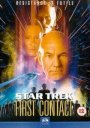
DVD
DVD The Prime Directive requires Starfleet not to interfere with the natural development of other civilisations. When Picard discovers that Starfleet itself is prepared to undermine those principles, he and the crew of the Enterprise are forced to choose between following orders and protecting the inhabitants of a paradise planet.

Details
Whilst Captain Picard and the Enterprise crew are occupied with a series of increasingly tedious diplomatic duties, Data is taking part in a covert Federation observation mission on the peaceful Ba'ku homeworld. However, something goes seriously wrong when the android apparently malfunctions, attacks members of the observation team and exposes their hidden presence to the planet's inhabitants.
With Starfleet preparing to destroy Data before he can cause further damage, Picard diverts the Enterprise to the planet and personally intervenes. After successfully recovering his officer, he begins investigating what caused Data's unusual behaviour and rapidly discovers that Starfleet hasn't been entirely honest about its activities.
The Ba'ku appear to be a relatively primitive agricultural society of only a few hundred people, living without much of the technology routinely used by the Federation. However, appearances are deceptive. The Ba'ku aren't technologically primitive at all; they've deliberately rejected advanced machinery in favour of a simpler existence based around their community and the natural environment.
More importantly, the unusual metaphasic radiation surrounding their planet has remarkable regenerative properties. The Ba'ku age extremely slowly and the radiation is even capable of reversing some of the effects of ageing and injury. Understandably, such properties are of enormous interest to the Federation and their new allies, the Son'a.
Unfortunately, exploiting the radiation requires the Ba'ku to be removed from their home. Admiral Dougherty and Son'a leader Ru'afo have therefore devised an elaborate plan to secretly relocate the entire population to another planet, allowing them to harvest the radiation without the Ba'ku ever knowing what happened.
Picard is appalled. Whatever benefits the radiation may offer the Federation, forcibly removing an entire population from its home is something he refuses to accept. When Starfleet orders him to stand aside, Picard removes his uniform and prepares to defend the Ba'ku himself.
He doesn't remain alone for long. The Enterprise crew choose to join their Captain, with Picard and several officers remaining on the planet to protect the Ba'ku whilst Riker and Geordi attempt to take the Enterprise out of the system and inform the Federation Council about what is really happening.
Meanwhile, the regenerative effects of the planet begin having some unexpected effects on the crew. Old injuries start healing, Geordi experiences a particularly remarkable change and Riker and Troi discover that the planet may be capable of rejuvenating more than just damaged tissue.
Picture & Sound
The picture quality on both editions is excellent. The image is bright and sharp with no significant signs of artifacting or other compression problems, although I felt the Region 2 edition's contrast was perhaps set a little too high.
The colourful Ba'ku planet provides plenty of opportunity for the transfer to demonstrate what it can do. The lush countryside, blue skies and brightly lit village are a considerable contrast to the dark starship interiors normally associated with Star Trek, and colours are particularly rich and vibrant throughout these sequences.
The space scenes are equally impressive, with the colourful gas cloud surrounding the planet looking especially good. Black levels are strong and there's plenty of detail visible in both the Enterprise and Son'a vessels.
Unfortunately, the clarity of the transfer is occasionally a mixed blessing. Some of the computer-generated effects don't stand up quite so well when presented this clearly, particularly the small pet creature seen on the planet's surface. Rather than blending naturally into the live-action footage, it's sometimes painfully obvious that the actors are sharing the screen with something created inside a computer.
That's hardly a fault with the DVD transfer, of course. If anything, it's a compliment: the picture is good enough to expose weaknesses in the original effects.
The Dolby Digital 5.1 soundtrack is superb and comes particularly alive during the space sequences. Ships move convincingly around the surround channels and there's plenty of directional activity during the battles, whilst explosions provide the subwoofer with a reasonable amount of exercise.
The quieter moments aren't neglected either. Jerry Goldsmith's excellent score spreads nicely across the soundstage and the various atmospheric effects aboard the starships and on the Ba'ku planet help create a convincing environment. Dialogue remains clear and precisely positioned in the centre channel throughout.
One irritation with the Region 1 edition is that the disc defaults to standard Dolby Surround rather than Dolby Digital 5.1, meaning you have to remember to select the superior soundtrack before starting the film. It's an annoying habit that some studios persist with and one that really should have disappeared by now.
The Region 2 edition thankfully defaults to English Dolby Digital 5.1 and also includes German and Hungarian 5.1 soundtracks. However, squeezing those additional tracks onto the disc has resulted in the Dolby 2.0 soundtrack from the Region 1 edition being dropped. Hardly a major loss as far as I'm concerned, but it's worth mentioning for completeness.
Menu & Extras
Unfortunately, neither edition is particularly impressive when it comes to presentation or supplementary material. The menus are static, silent and disappointingly unimaginative. Given the wealth of computer displays and imagery available from the Star Trek universe, Paramount really could have made more effort.
The main supplementary feature is the Behind the Scenes featurette, which provides a brief look at the production and includes the expected collection of cast and crew interviews. It's interesting enough whilst it lasts, but hardly the substantial making-of documentary a major film like this deserves.
The Region 1 edition also includes the theatrical trailers, whilst Region 2 provides both the teaser and theatrical trailer. Again, they're worth having, but trailers and a promotional featurette hardly amount to an exhaustive collection of extras.
It's especially disappointing when you consider just how much material Paramount could presumably have supplied. Interviews with Jonathan Frakes about directing his second Star Trek film, a commentary, deleted scenes, production-design material and a proper look at the visual effects would all have been obvious additions.
Instead, both editions feel rather bare. Paramount may finally have committed themselves to the Region 2 DVD market, but they still have some way to go when it comes to exploiting the format properly.
Overall
Certain people always say that the odd-numbered Star Trek outings are the weakest and, looking back at some of the previous films, there's certainly evidence to support the theory. However, Insurrection breaks the mould with a particularly good script, even if there isn't quite as much action as some viewers might expect.
In fact, the relative lack of action is one of the reasons I enjoyed it. Rather than simply inventing another enormous enemy vessel for the Enterprise to shoot at for two hours, the film gives Picard a moral problem. What happens when the organisation you've spent your life serving asks you to do something that goes against everything it's supposed to represent?
The Prime Directive has always been one of the fundamental principles of Star Trek, yet here we have Starfleet attempting to justify the forced relocation of an entire population because the potential benefits are considered sufficiently important. Picard's response is simple: principles aren't worth very much if you abandon them the moment they become inconvenient.
There are obvious parallels with events taking place here on Earth. Unless the American government aren't telling us something about the events of First Contact, the forced removal of the Ba'ku from their home has all the hallmarks of the ethnic cleansing we've been seeing in the Balkans.
That gives the film a topical edge without overwhelming the science-fiction story. The Ba'ku aren't being exterminated and Starfleet have convinced themselves that relocating six hundred people is a small price to pay for medical benefits that could potentially help billions. It's precisely that apparently reasonable argument that makes Picard's dilemma interesting.
Of course, once Ru'afo starts behaving like a conventional villain the moral ambiguity becomes rather less complicated. F. Murray Abraham certainly throws himself into the role and his increasingly unpleasant appearance makes it fairly obvious we're not supposed to spend too long wondering whose side we're on.
Patrick Stewart is excellent as usual and seems particularly comfortable when Picard is given something more substantial to do than shout orders from the bridge. His relationship with Anij also provides a quieter side to the character and allows the regenerative effects of the planet to influence him in ways beyond simply making him feel younger.
There are plenty of subtle moments throughout the film that probably make this one of the best Star Trek outings so far. The scene where Anij appears to slow Picard's perception of time is particularly effective and provides a welcome contrast to the usual phasers, photon torpedoes and exploding control panels.
The rest of the Enterprise crew also get their moments. Geordi's temporary restoration of his natural eyesight is surprisingly touching, particularly because he chooses to watch a sunrise with his own eyes for the first time in years rather than immediately running around looking at everything in sight.
Riker and Troi, meanwhile, rediscover their attraction to each other under the influence of the planet. This provides several of the film's better comedy moments and allows Jonathan Frakes and Marina Sirtis to revisit a relationship that had largely disappeared during the later television seasons.
Worf's encounter with Klingon puberty is considerably less subtle but still amusing, whilst Data gets some nice moments attempting to understand the Ba'ku children. There's a warmth to the interaction between the characters that occasionally makes the film feel more like an extended episode of The Next Generation than a huge cinematic adventure.
Some people will probably regard that as a criticism, but I'm not sure it necessarily is. One of the strengths of Star Trek has always been its ability to tell smaller stories based around ideas rather than simply spectacle, and Insurrection is quite happy to spend time with its characters rather than blowing something up every five minutes.
That's not to say there's no action. The Enterprise's confrontation with the Son'a ships provides Riker with plenty to do, whilst Picard eventually gets the expected final showdown with Ru'afo aboard the collector. The effects are generally impressive, even if a few of the computer-generated creatures on the planet are rather less convincing.
The film also benefits from not becoming bogged down in enormous amounts of Star Trek mythology. Existing fans will obviously get more from the relationships between the characters, but the central story is straightforward enough that a casual viewer shouldn't need an encyclopaedic knowledge of the television series to understand what's happening.
For me, it's the smaller character moments and moral questions that make Insurrection work. First Contact may have provided considerably more action and a more immediately threatening enemy, but this feels closer to the sort of story that made The Next Generation enjoyable in the first place.
And yes, I'll probably upset a few Trekkies by saying it, but there are enough good moments here to make this possibly the best Star Trek film so far. It doesn't have the scale of some of the previous outings, but it has a good script, strong performances, plenty of humour and an actual idea sitting underneath all the special effects.
As for the two DVD editions, there's very little between them. Picture quality is excellent on both, the Dolby Digital soundtrack is impressive and the extras are equally disappointing. Region 1's irritating decision to default to Dolby Surround doesn't exactly help its case either.
If a Region 2 edition is on a par with its Region 1 counterpart then I'll always recommend buying locally, and that's certainly the case with Insurrection. There's simply no compelling reason to import the American disc.
Finally, Paramount appear to have committed themselves to the Region 2 market. That's certainly welcome, although they also deserve some criticism for being such a late entrant. Hopefully this means we'll soon see the complete collection of Star Trek films appearing on our shelves.
A strong film, an excellent transfer and a disappointing collection of extras. Region 2 takes the honours - and the odd-numbered Star Trek curse can take the day off.
Special features
Region One Edition
- Theatrical Trailers
- Behind the Scenes Featurette
Region Two Edition
- Teaser Trailer
- Theatrical Trailer
- Behind the Scenes Featurette
- English, German and Hungarian 5.1 Soundtrack