 DVD
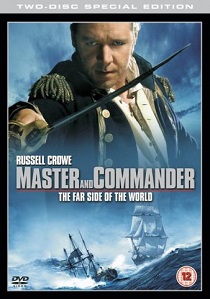
DVD HMS Surprise. 28 guns... 197 souls. Coast of Brazil, April 1805. "Intercept the French privateer Acheron... you will sink, burn or take her as a prize."

Details
With Britain and France at war and Napoleon's armies threatening the shores of England, it fell to the Royal Navy to defend the country and her fledgling empire. But when Napoleon threatens to extend the war by sending the French privateer Acheron to the South Pacific to harry British shipping and interests in the region, HMS Surprise is dispatched to intercept and sink, burn or capture the vessel. Commanded by Captain Jack Aubrey - known as "Lucky Jack" to his crew - he is well respected by his men and trusted implicitly. With plenty of naval victories already under his belt, this French ship should prove no real threat and a profitable prize will surely be enjoyed by all.
However, British intelligence is patchy and the crew of the Surprise soon discover to their cost that the hunter has become the hunted. The French vessel has been tracking them and, when it attacks from within a fog bank, the Acheron inflicts heavy damage and casualties on the Surprise. Virtually crippled by well-aimed shots to the rudder and masts, Jack soon realises that HMS Surprise is outmanned, outgunned and outpaced. Rejecting calls from his officers and crew to return to Portsmouth, Jack remains determined to carry out his orders and instead instructs the men to repair the ship and prepare for battle. After all, they do not call him Lucky Jack for nothing and he is not about to let the French captain get the better of him so easily.
So begins a cat-and-mouse game of evasion and pursuit as the British ship attempts to avoid the French vessel while manoeuvring into a position from which it can strike. There is even time for a venture to the Galapagos Islands to resupply and to allow the ship's surgeon, Dr. Stephen Maturin, the chance to make some remarkable discoveries about the islands' wildlife and the process of natural selection. But while exploring the island, the scientific party spots the French vessel sailing around the far side. Man the cannons - it looks like we have a fight on our hands.
Picture & Sound
The picture appears to be deliberately restrained, but nevertheless still offers an image that is bright, colourful and rich in detail. In fact the picture is so precise that many of the CGI effects are difficult to detect. The bit-rate remains continuously high and there are no problems with artifacting, outlining or grain. The only time the image appears to struggle is during scenes containing the encoder's ultimate nightmare of smoke and fog. Although these moments are few and far between, the unpredictable movement of the smoke causes some minor grain and pixelisation. With a large budget and a theatrical release in 2003 it is only natural to expect a pristine transfer, and you will not be disappointed as the image is virtually flawless.
Twentieth Century Fox seem to have been treating their newer releases with a little more care around this period. As with their DVD of The League of Extraordinary Gentlemen, the film is accompanied by both Dolby Digital 448Kbps and DTS 768Kbps soundtracks. And rather than including the DTS track merely for the sake of it, Master and Commander truly revels in the opportunity to show off both formats. What better scenario than a swashbuckling adventure at sea, complete with creaking ships and pounding cannons?
Past experience with action and adventure films has shown on far too many occasions that action does not necessarily guarantee an exciting soundtrack. Fortunately, Master and Commander gets it absolutely right. It is the sort of soundtrack that all Hollywood producers ought to sit down and study if they want to know how to create a genuinely dynamic mix. Although both tracks are excellent and provide clear, precise and well-directed dialogue, it is the superior separation and dynamics of the DTS mix that give it the edge over its Dolby rival.
In channel terms it is the often-neglected LFE that really steals the honours, delivering impressive room-shaking impact during the many battle scenes. The surround channels are not used merely for show, but instead do a wonderful job reproducing the ambient sounds of life aboard ship, from the creaking hull to the movement of the crew. It is always a compliment to a soundtrack when you do not consciously notice its presence - until battle erupts and every channel bursts to life with cannon fire, splintering wood and chaos all around the room.
While the Dolby Digital track is certainly no slouch, it lacks that final killer edge which the DTS version reproduces so effortlessly. Nevertheless, both formats provide a soundtrack that will not disappoint and will certainly give your surround system a serious workout. I can easily imagine this disc being used for demonstrations in more than a few hi-fi shops.
Menu & Extras
The menus are pleasantly animated and scored, with each subsequent section beginning with some animation before settling into a static screen with the options displayed along the bottom. It may not be the most elaborate menu system ever to sail the DVD seas, but it is perfectly functional with everything easy enough to find.
As with Twentieth Century Fox's release of The League of Extraordinary Gentlemen, you have the choice between a single-disc edition of the film and this fully loaded two-disc version with more extras than you can shake a mackerel at. While LXG badly needed the extras, if you are simply a film fan and not overly fussed about supplemental material then the single-disc edition of Master and Commander may do you just fine. However, the extra disc is worth every additional penny and you would miss out on a veritable bucket-load of fascinating material.
The first disc cannot really be said to include any genuine film-related extras. Once you have skipped past the increasingly irritating number of trailers (why are these not placed on their own menu?), the only additional feature is a teaser for the forthcoming theatrical release of I, Robot. I do not know about anyone else, but to me that film bears an uncanny resemblance to The Second Renaissance segment from the Animatrix series. I am not entirely sure who is borrowing from whom, but somebody is certainly pinching someone else's ideas.
The main attraction is the 68-minute making-of documentary The Hundred Days. Some of my previous reviews may have mentioned how interesting certain making-of featurettes were, but this one takes the biscuit - indeed, it takes the whole packet. From the initial script work to the design of the sets, the special effects and the minute historical touches, director Peter Weir explains everything in fascinating detail. There is no doubting his enthusiasm for the project and I was so captivated by the featurette that I was genuinely surprised when it ended.
The highlight of this documentary has to be the special effects section. While watching the film I found myself commenting on what I assumed were obvious CGI effects, only to discover that much of the footage actually involved a real ship and a 1/8 scale model, with CGI added only when required. Rather than relying solely on computers to generate storm effects, the production team incorporated actual storm footage shot from the replica Endeavour as it voyaged around Cape Horn. This was then blended into the film to make the seas as realistic as possible. This, quite simply, is how you use CGI properly.
The only downside to the featurette is the limited contribution from Russell Crowe. And when he does appear, he is hardly overflowing with insight. In the entire documentary he cannot have had more than two minutes of screen time. While most of the principal cast members contribute generously, it is left to Peter Weir, the stunt coordinators and the musicians to tell us more about Crowe than Crowe does himself. Pretentious Hollywood big-head? I would say so.
Next up is the more personal featurette Peter Weir on Directing - In the Wake of O'Brian. Here Weir discusses the inspirations behind the script, from buying Patrick O'Brian's novels and spending much of his fee on British naval memorabilia to visiting museums and grilling naval experts on everything from sea battles to the daily life of an ordinary sailor. It is here that his enormous enthusiasm for the project becomes most obvious. Everything from the type of nails used in the timbers to the material chosen for the ropes and sails is discussed in admirable detail, and the piece doubles as a rather interesting history lesson.
The 25-minute HBO First Look special is essentially a condensed reworking of the main making-of featurette. However, it does include some additional cast and crew interviews and even the ever-elusive Russell Crowe manages to say a few extra things. If you have not already had your fill of special effects discussion, the 30-minute Special Effects Documentary - Cinematic Phasmids goes further into the ships, the CGI work and the extremely interesting scale models, revealing just how much effort went into making them appear convincing on screen.
Related to the special effects material is the Sound Design Documentary. This 18-minute feature follows the crew as they go about capturing the sounds of cannon fire and its effect on wood and cloth. Their chosen method is refreshingly straightforward: head to an army firing range and let rip with a selection of cannons while placing microphones in various positions around the target. The result is another thoroughly interesting featurette which leads neatly into the Canon Sound - Interactive Sound Recording extra, allowing you to listen to the various recorded positions and layer them together into a basic but effective surround demonstration.
There are also six deleted scenes, running to a total of 23 minutes. They do not really add much to the story and were most likely removed for pacing reasons in what is already quite a lengthy film, but they are still welcome and, pleasingly, are subtitled too. The Multi-angle Shooting section allows you to view a number of battle scenes from different positions using four camera angles, a B-roll and a composite view. Rounding things off is a Stills Gallery containing conceptual art, naval paintings and technical drawings of the various set pieces. Oddly enough, despite Fox heavily promoting the film on other discs for months, the trailer itself is nowhere to be found here. Oh well, you cannot have everything.
Overall
It is refreshing to finally see a major period action film in which the heroes are not American, the villains are not the British and, for once, the nasty French are the ones getting a good hiding. The only possible cloud on the horizon is that between the various sea battles the film occasionally pauses to spend time on the Galapagos Islands and explore the comings and goings of the crew. As a result, the more impatient action addicts may start fidgeting in their seats. For everyone else, however, the running time is likely to fly by.
The historical detail of the ships and their crew is superb, right down to the smallest button, and by watching the featurettes on the second disc you quickly realise just how much care and effort the production team invested in recreating the period. Given that it took the deep pockets of both Twentieth Century Fox and Universal to bring the project to the screen, it seems highly unlikely that we will see another historical nautical epic quite like this any time soon. It is magnificent cinema and one could very reasonably argue that it was rather unfortunate to come up against The Lord of the Rings: The Return of the King at the Oscars. Highly recommended.
Special features
Disc One
- Inside look at I, Robot
Disc Two
- Making of Featurette - The Hundred Days
- Peter Weir on Directing - In the Wake of O'Brian
- Special Effects Documentary - Cinematic Phasmids
- Sound Design Documentary
- HBO First Look Special
- 6 Deleted Scenes
- The Last Battle Multi-angle studies. Camera setups and split screen vignette
- Four Stills Galleries
- Canon Sound - Interactive Sound Recording